
Questions, Questions.
In a wilderness full of questions, John pointed beyond himself to the Lamb of God.
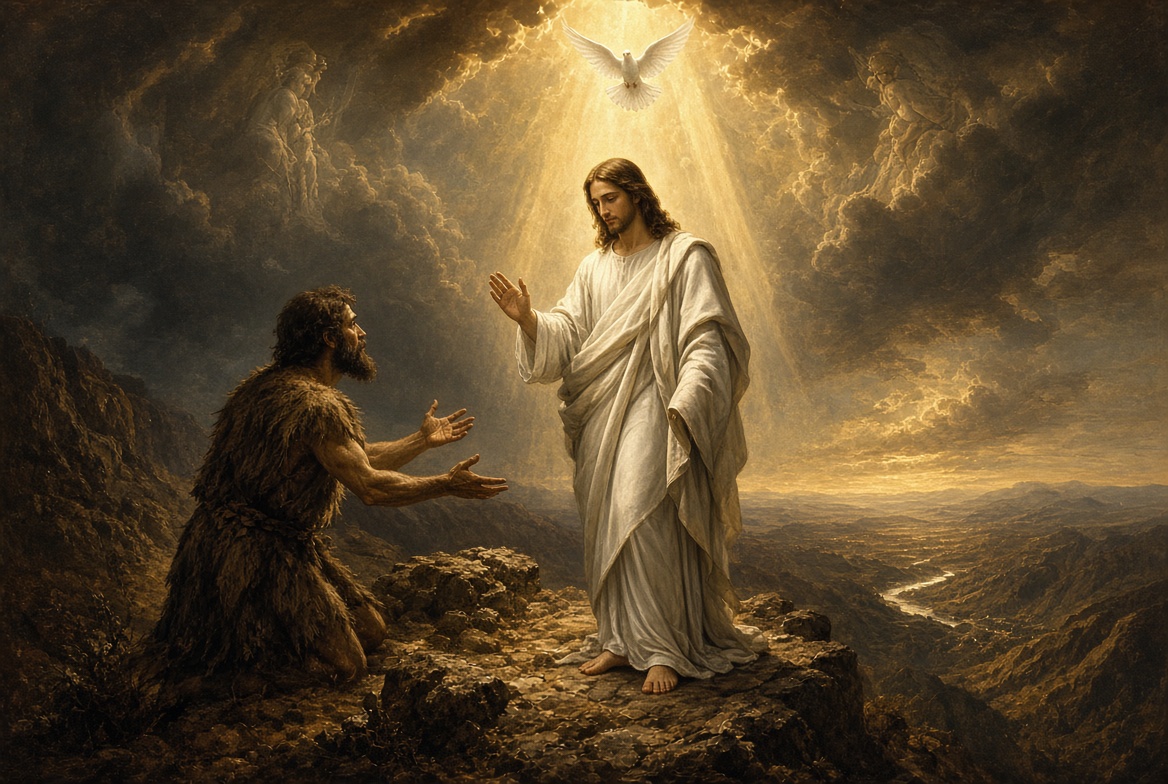
During this time, there were a couple of expectations for what the Messiah might look like. On the one hand, there was the idea of a Davidic king who would bring sovereignty back to the country through military might and royal power. On the other hand, there was a priestly expectation, as seen in passages from Psalm 22, Isaiah 53, and Zechariah 12. Most were expecting the military campaign, although some, such as the Essenes, seemed to expect two Messiahs to fulfill each role at the same time. Jesus came without might, and met the second of these, which was a very much minority opinion. However, Revelation 19 tells us that the Davidic expectation isn’t forgotten; it’s still to come.
There is a strange paradox here. On the one hand, Jewish leaders were sending people out to John, the madman in the desert who ate bugs, wore scratchy clothes, and was likely in bee stings from raiding honey, to find out if he was the one. I would argue that this was more about due diligence than a serious investigation and belief that he could be a contender. On the other hand, a bunch of them were upset with Jesus because he didn’t arrive surfing the clouds and zapping the Romans with laser beams from his eyes, while simultaneously ruling the world. There were quite a few claiming to be the Messiah wandering around back in the day. According to Josephus, there was Theudas, Judas the Galilean, and an unnamed Egyptian who led 30,000 followers into the desert (although this number is disputed, and Acts tells us it was likely around 4,000), but I have to say, it’s not something I would have wanted. The Romans considered these people a serious threat and suppressed these insurrections without mercy, making the roles of John and Jesus, and the enduring message over the millennia, even more impressive.
I have wondered what the people who had been sent to him thought. What did they report back? “Yeah, so… Um… Look, he’s a bit out there, you know. I am quite convinced he isn’t the one. In fact, I am surprised he isn’t claiming to be Napoleon…” With that said, the fact that John continued to have person after person coming to him demonstrates one very important truth: if you are giving God’s true message, people will come to you.
I often see people on social media saying that people aren’t coming to their church because of the “sin in that person’s life” that they don’t want to give up. However, history shows us that wherever the word of God is shared and a call to repentance is unashamedly preached, people will be there. People want to be reconciled to their Creator and to have peace about their eternity. They don’t want to be subjected to holy karaoke, nor do they want to be talked at for an hour about the ins and outs of what some word means in the Greek. As interesting as this is, and for the theologian this can be extremely fascinating, people don’t want to meet with other believers to learn Greek; they want to meet with Jesus and relate with other people. To be clear, I’m not saying there’s no value in learning Greek or expository preaching. Dr. J. Vernon McGee is my favorite Bible teacher, and even with basic knowledge of Greek and Hebrew, understanding both can bring the message to life in ways plain English can’t. Dr. McGee died in 1988, but his radio program, Thru the Bible, is still running and reaching millions of souls every day. However, the most important thing people want is a relationship with God; not everyone will be called to learn the depths of theology. As I said at the beginning, this book isn’t meant to be a deep theological tome.
John was a popular individual and was causing quite a stir, with questions over whether he was “the one,” a prophet, or even Elijah.*1,*3 He denied all this and claimed to be just a nobody, not even worthy to tie up Jesus’ sandals. He wasn’t trying to gain disciples for himself or recruit numbers to his meetings; his mission was to promote Jesus. He had no promoter, no youth pastor, no director of media, and no PR guy, just John and his love of God. He had no ministry support, no platform promoted on socials, and no clear ministry strategy, just an uncompromised message, which may be all it takes.
John typically had a lot of people around him, including people sent by the religious leaders of the day. He was causing a stir, which wasn’t well received by the Jews or the Romans, who had both settled into an uneasy rhythm of daily life in which each tried not to upset the delicate balance of social life.
It was in this melee that Jesus approached John, and John told the people with him that Jesus was the one. This was the one John had been talking about when he said he was not worthy to tie his sandals. I can imagine some of the discussions: “What? This guy from Nazareth? He was putting in my kitchen cabinets last week, and this week he’s the anointed Lamb of God? I wouldn’t have thought so…”
Furthermore, to add to his already less-than-stable image, John recounted to the people with him that when he baptized Jesus, God had spoken to him and said that whoever he saw the Spirit, like a dove, land on was the Lamb of God. This was the one, John said, who had gone before him, and was now coming after him, not confusing at all. These were some quite big claims, but John gave an even bigger one, which would have raised some eyebrows. He said that Jesus would take away the sin of the world.*14 This was nothing short of outright blasphemy, because everyone knew that only God could take away sin (we’ll see Jesus upset religious leaders later with this same claim). This was quite possibly the most explosive statement John made, which would doubtless have put a spotlight right on Jesus.
Had John said “this is the Messiah,” or “this is the prophet,” he would have said nothing new; there were messiahs all over the place preaching some message or another. However, taking away sin was, is, and always will be God’s job, and God’s alone. In this one statement, John’s testimony presents the Father, the Son, and the Holy Spirit together. John showed here that he understood Jesus was not just another prophet but, in fact, none other than God incarnate.
And this is how Jesus crashed into history with the introduction of “This is the Son of God!”
14 The Lamb who bears the sin of many — Isaiah 53:6–7, 12; John 1:29.
Stay Updated on Finding Jesus
Join the mailing list to receive weekly updates as the story unfolds.