
The Wisdom: Long-Term Consequences
Week 5

About This Week
Each week I’ll post an overview of what to expect in the upcoming week. This week we’ll be building another foundation for a closer walk with God through long-term, eternity-shaped thinking. As I said in the overview of this devotional, the goal is to tie psychology and Scripture together, and this overview explains why God calls us to number our days, not to live in anxiety about the future, but to gain a heart of wisdom that orients every present choice toward what will last.
There’s a reason Scripture calls us to consider where our choices may lead, and how they may affect us and others in the future. There are a number of terms we might use to describe this, including future orientation, temporal discounting, delayed gratification, strategic foresight, or long-range planning, but it always boils down to the same thing: human beings flourish when they align their decisions with what matters most in the long run, rather than defaulting to whatever is easiest or most comfortable right now. Research continues to show that people who orient their thinking toward the future demonstrate better self-regulation and decision quality, and greater resilience when difficulty comes.
What Long-Term Thinking Actually Is
Wise long-term thinking isn’t pessimism about the present or obsession with the future, but asking, “Where will this lead?” and considering the eternal consequences as well as the temporal ones. This may seem to be a heavy burden, but Scripture presents this as a gift: “So teach us to number our days, that we may gain a heart of wisdom” (Psalm 90:12). Numbering your days isn’t morbid; it’s a realistic assessment of our eternity. It helps us consider what we might see as urgent in comparison to what is important.
This can be tough because many of us don’t really think long-term; we have so many demands that it’s all we can do to manage the immediate. We respond to urgency, optimize for comfort, and often put off the hard work of examining where our habits, patterns, and choices are slowly carrying us. God’s design for wise living involves weighing decisions with a longer viewpoint, spiritually, relationally, financially, and professionally, not only asking “What do I want?” but “What will I wish I had chosen?”
What Research Shows
Research on future-oriented thinking has produced consistent findings across academic, health, and vocational contexts. A systematic review of 21 studies found a clear relationship between future-oriented thought and positive outcomes in academic settings, including greater engagement, better performance, and higher self-regulatory behavior (Pawlak & Moustafa, 2023). Those who maintained a clear sense of their desired future demonstrated stronger effort and better follow-through than those without that orientation. In short, where you are looking shapes how you walk.
Research on delayed gratification found that it predicted not only financial responsibility, such as less credit card debt and more consistent saving, but also broader life outcomes including lower substance use, fewer risky behaviors, and greater life satisfaction across four studies, and this held even after controlling for impulsivity, sensation seeking, and numeracy (Reyna & Wilhelms, 2017). This is important because it suggests that the values people hold about sacrifice and future reward, not just their cognitive ability to calculate trade-offs, influence their behavior across many domains of life. That is not far from what Proverbs describes when it tells us that wisdom is formed in the heart before it is expressed in the hand.
Future orientation is also important in how we handle life’s major turning points. A 2024 study found that social support reduced career decision-making difficulty indirectly through psychological capital and decision-making self-efficacy, suggesting that being supported in long-term thinking builds the internal resources needed to navigate uncertainty with clarity rather than paralysis (Zhou et al., 2024). Wisdom, it turns out, tends to travel in patient, relational, long-horizon company.
Why This Matters Spiritually
The spiritual value of long-term thinking isn’t just that it produces better outcomes, but that it trains us to live as people whose citizenship, as Paul says, is in heaven, for whom the visible and temporary is not as important as the invisible and eternal. Jesus’ question in Matthew 16:26, “What will it profit a man if he gains the whole world and forfeits his life?”, is a question about the slow drift of a thousand small choices made without asking where they lead. As Casting Crowns wrote, it’s a slow fade.
This means that long-term thinking is a spiritual discipline, not just a productivity strategy. When we pause before a decision and ask, “How will this look in ten years? In eternity?”, this is wisdom in practice. It’s what Joseph did in Egypt, what the Psalmist prayed for, and what Jesus modeled in Gethsemane when He chose the eternal will of the Father over the immediate relief His humanity craved.
Seven Practices for a Life Shaped by Eternity
The following seven reflections will shape this week’s journey into long-term, eternity-oriented decision-making as a pillar of godly wisdom:
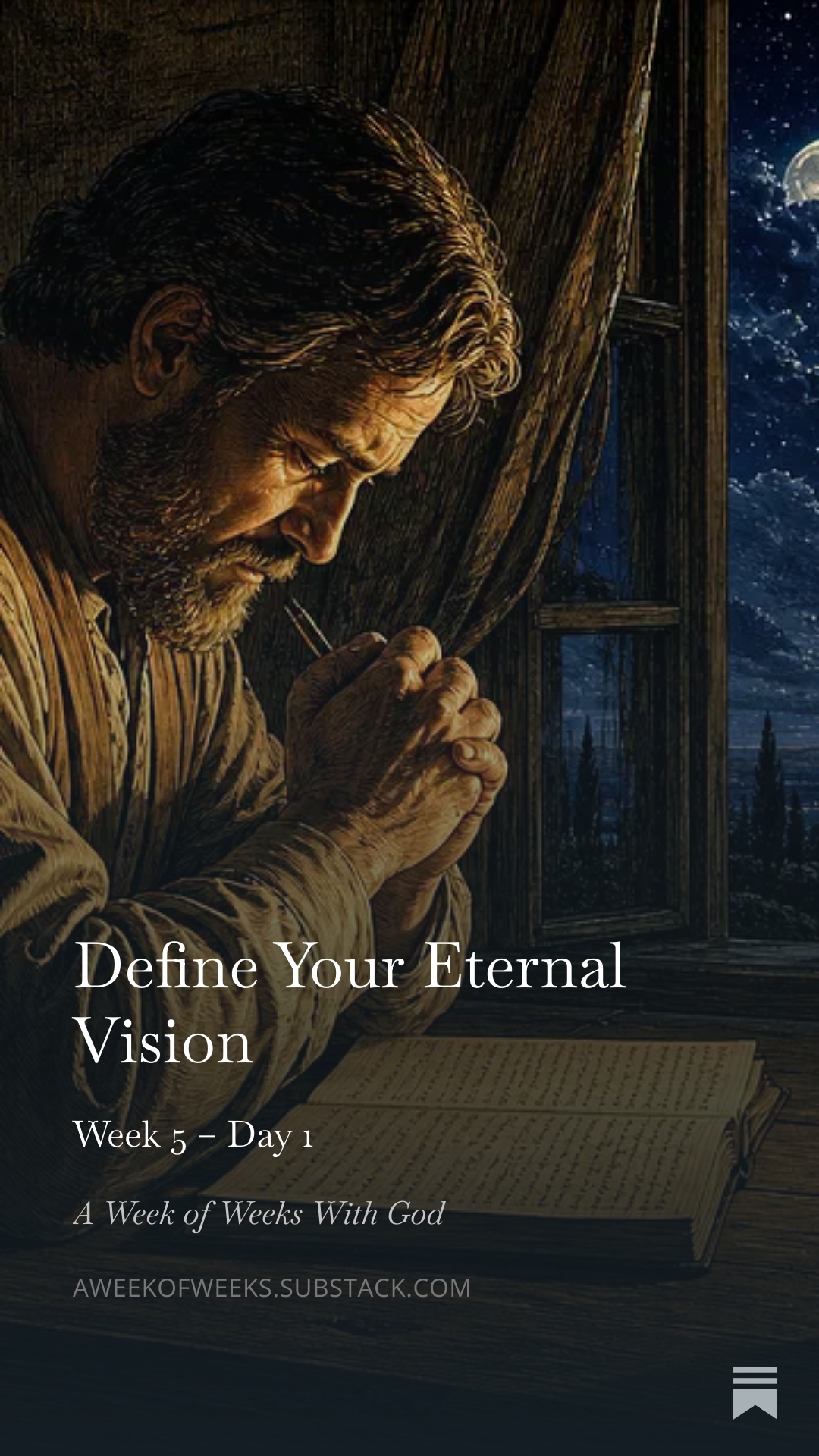
- Day 1 — Define Your Eternal Vision
“So teach us to number our days, that we may gain a heart of wisdom.” (Psalm 90:12) - Day 2 — Map a Recent Decision’s Impact
“The prudent man sees danger and takes refuge, but the simple pass on, and suffer for it.” (Proverbs 22:3) - Day 3 — Practice Sacred Delayed Gratification
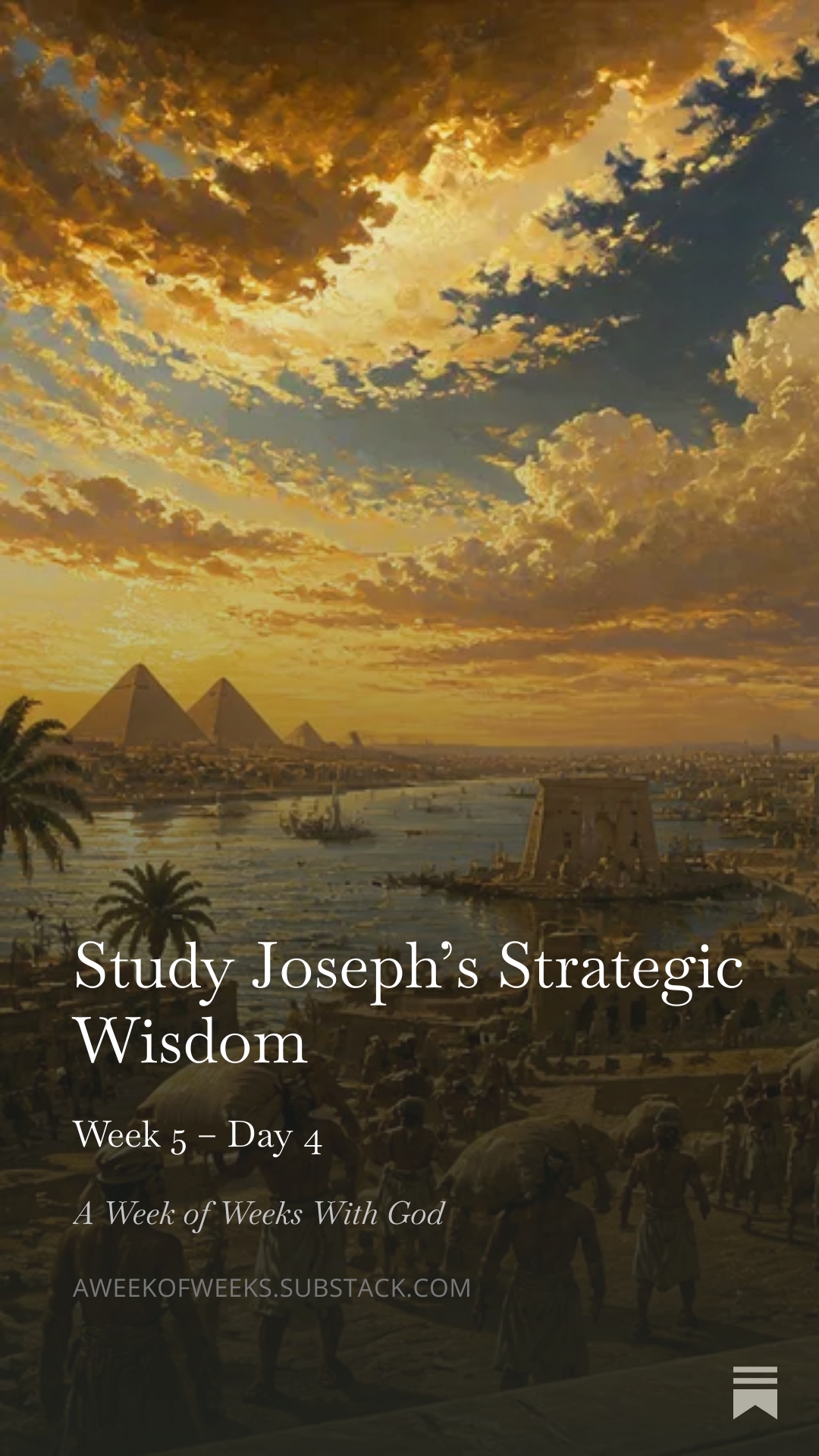
“Man shall not live by bread alone, but by every word that proceeds out of the mouth of God.” (Matthew 4:4) - Day 4 — Study Joseph’s Strategic Wisdom
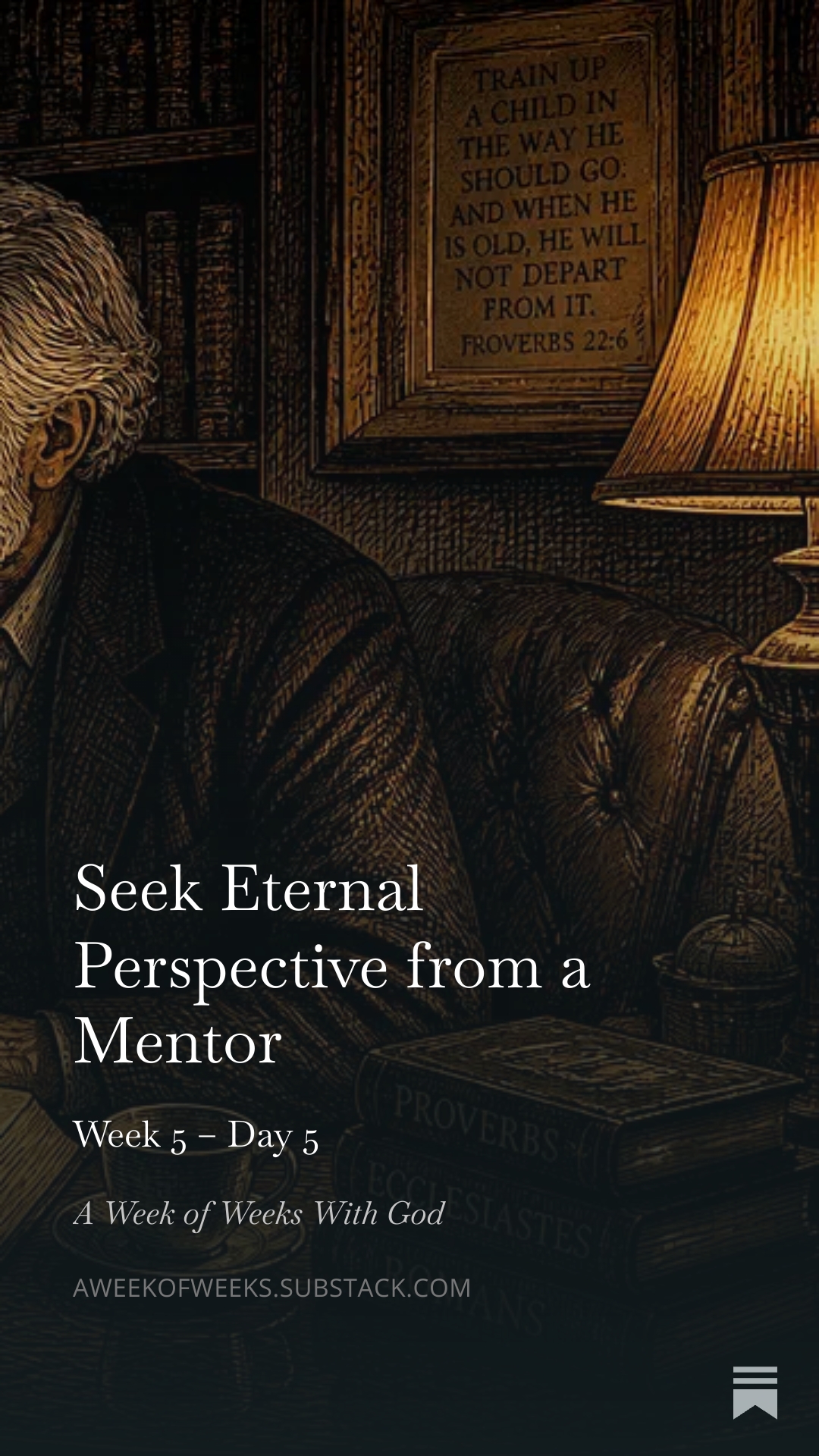
“Let Pharaoh… appoint overseers over the land, and take up the fifth part of the land of Egypt’s produce in the seven plenteous years.” (Genesis 41:34) - Day 5 — Seek Eternal Perspective from a Mentor
“For what will it profit a man if he gains the whole world, and forfeits his life?” (Matthew 16:26) - Day 6 — Practice Eternity Thinking
“For what will it profit a man, if he gains the whole world, and forfeits his life?” (Matthew 16:26) - Day 7 — Commit Your Future to God
“My times are in your hand.” (Psalm 31:15)
A Life Oriented Toward What Lasts
The lesson this week is both old and urgent, reminding us that wise living requires looking up and looking forward, not only responding to what is immediate. Research describes the benefits in terms of self-regulation, decision quality, resilience, and life satisfaction; Scripture describes it as numbering your days, choosing the word of God over bread, and entrusting your times into hands wiser than your own.
The discovery this week may be that eternity-shaped thinking does not make the present smaller — it makes it more meaningful. We are not called to escape the present, but to inhabit it with purpose. God does not ask us to predict the future; He asks us to trust the One who holds it.
Pawlak, E., & Moustafa, A. A. (2023). A systematic review of the impact of future-oriented thinking on positive outcomes in academic settings. PubMed. https://pubmed.ncbi.nlm.nih.gov/37404582/
Reyna, V. F., & Wilhelms, E. A. (2017). The gist of delay of gratification: Understanding and predicting problem behaviors. PubMed. https://pubmed.ncbi.nlm.nih.gov/28808356/
Zhou, A., Liu, J., Xu, C., & Jobe, M. C. (2024). Effect of social support on career decision-making difficulties. PubMed. https://pubmed.ncbi.nlm.nih.gov/38667114/
The Seven Days




Stay on the Journey
Get each new week’s devotional delivered straight to your inbox.