
Promises, Promises
Philip said, “Come and see.” Nathanael encountered the One who opens heaven.
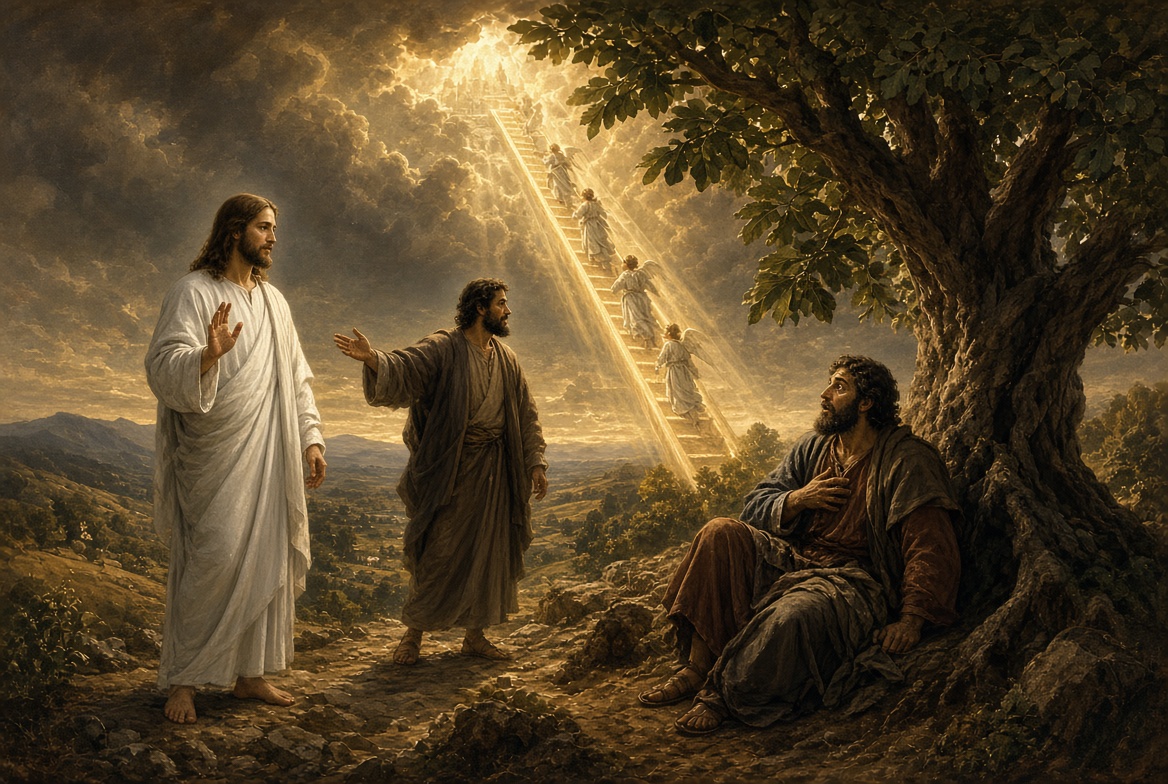
After calling Andrew and Peter, Jesus continued to expand his merry band by adding Nathanael and Philip. Philip came from Bethsaida, which was the same place as Andrew and Peter. It was entirely possible that Philip knew Andrew and Peter; we’re not talking about a thriving metropolis here. Once again, the introduction Jesus offered wasn’t really in line with social norms. There was no “Hi, I’m Jesus, want to come to a focus group to see what I am about?” There wasn’t any attempt to be relevant or any initiative to be “seeker-friendly.” Jesus simply said, “Follow me.”
Strangely, Philip did exactly that, but not before going to get a friend first. Again, what seemed to make sense to the one in direct contact with Jesus was questioned by the next person.
“Hey, Nate, we’ve found the Messiah, the real one that Moses and the prophets wrote about.”
“Yeah, where’s he from?”
“Nazareth.”
“Nazareth?”
“Um, yeah. I um… yeah, Nazareth.”
“So how did this Nazarene convince you he’s the one?”
“He said, ‘Follow me.’”
“OK, I just want to get this straight, because right now you don’t exactly seem to be in your right mind… You have met a guy from Nazareth who told you to follow him. From this, you have decided he is the promised Messiah?”
“Well… yeah.”
“Alright, I’m in. A Nazarene Messiah with Jedi skills is just what I need to brighten this day up.”
Little did Nathanael know, but he was about to be the latest victim of Jesus’ Jedi mind tricks. Upon meeting Jesus, he lived up to his growing reputation as the World Champion of the Most Random Introduction. Jesus greeted Nathanael by stating that he was an Israelite with no deceit, which, as an Israelite, Nathanael would have recognized the reference to Jacob, whose story included deception (Gen. 27). Nathanael asked Jesus if he knew him, and Jesus followed up by telling Nathanael that he had seen him sitting under a tree when Philip went to get him. Nathanael was obviously impressed with this, and Jesus told him that this was nothing and that Nathanael would see angels moving freely into and out of Heaven and talking to Jesus. Once again, this reference had more depth than may be first seen, as Jesus was referencing himself as the new Jacob’s ladder, the doorway to Heaven, as mentioned in Genesis 28.*15
There are so many things we can learn from this, but for me, one thing stands out. Once again, no one was impressed by the secondary telling of a meeting with Jesus. It wasn’t until the person met Jesus himself that he believed and was willing to sacrifice. I usually try to approach these scenarios with some humor and keep them quite light, but this is quite a sobering thought. It isn’t the message we bring that touches lives, although that is a part of it. Our theology and clever arguments don’t create believers, although they may help believers to grow in their faith. It certainly isn’t church membership laws and regulations. Nor do our personal pet doctrines lead people to salvation. Only the Holy Spirit brings a person to saving faith in Jesus, though God often uses the message we bring to lead them to Christ. While we may be the Philip who says, “Come see,” we have to make sure the person finds Jesus, and not church, rules, doctrines, or clever arguments.
15 Jacob’s ladder fulfilled in Jesus — Genesis 28:12; John 1:51.
Stay Updated on Finding Jesus
Join the mailing list to receive weekly updates as the story unfolds.