Really, Mum?
At a wedding in Cana, ordinary water became an unexpected sign of the Messianic age.
According to many comedians, the Jewish mother stereotype pushes their kids, nags, makes them do things they don’t want to do, and generally gets involved with their kids long after they should have let go. The perfect example is Howard Wolowitz from The Big Bang Theory. Not being Jewish, I can’t attest to its truth, but there is a story in the Bible that touches on this.
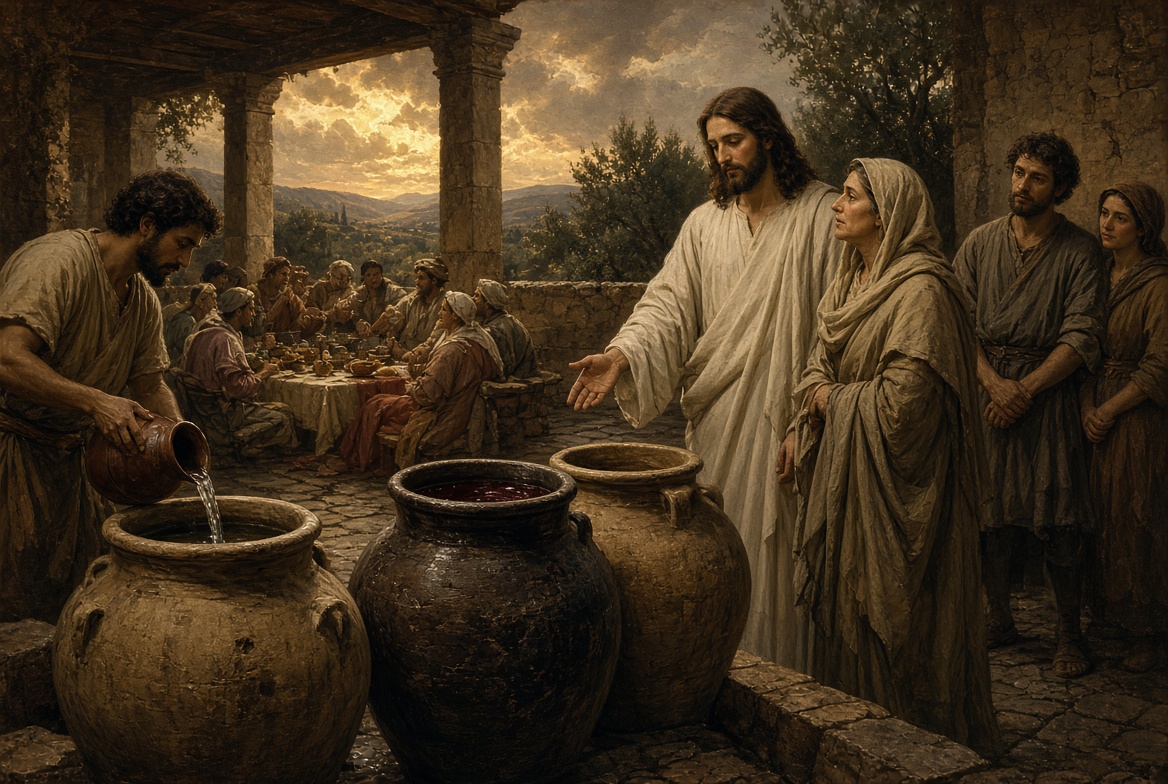
Jesus, aged 30, was at a wedding party with his friends, not up to anything special, just hanging out and chatting with people, when the news broke: “People! The booze is gone, party over!”*16 Enter Mary: “Hey, Jesus, get over here, son…”
A discussion ensued in which Jesus said his time for public ministry hadn’t arrived, but Mary insisted. Mary did not argue with him; she simply told the servants, “Do whatever he tells you”. Not pushy at all. It is fun to imagine the possibilities; if your kid is God, you may get a little over-confident in his abilities from time to time. I can almost picture Mary ruffling his hair and pinching his cheek as she told him to fix the dry party situation.
There is an important thing to consider here. While this was the first recorded miracle Jesus did, we have to wonder why Mary was so confident that Jesus could fix this. How many times might he have turned rocks into bread while wanting a snack? As a teen, might he and a group of friends have enjoyed a sneaky jug of wine when the parents weren’t around? It would certainly have been harder to lock up an entire well than simply locking the alcohol cabinet. Of course, we know from the temptation in the desert that Jesus refused to turn stones into bread for himself, but helping an already roasted wedding party for his mother seemed to be a different matter entirely. No good son wants to let his mother down, especially if she’s talking him up in public. This is, of course, speculation; John calls Cana the beginning of Jesus’ signs.
Jesus, halfway between a rock and a hard place, with his mother on one side and his not being ready on the other, told the servants to fill the jars with water, and the rest is history. There is one thing of note here that not many people choose to point out in church on a Sunday. The wine was all gone, even the cheap stuff. Weird Uncle Fred was at the stage where he was dancing with half of his shirt hanging out, and the best man was flirting with the bridesmaid. The head waiter was amazed that the bridegroom would save the best wine for last, because usually the cheap brand was served at the end, when many in attendance couldn’t tell their fine wine from the Boone’s Farm.
This, in itself, becomes a theological nightmare for many people, but there is more to it. Jesus didn’t just ask for any containers of water; he asked for the stone jars used for Jewish purification. Again, to clarify, this sets the tone for a common theme we will see throughout Jesus’ ministry: Jesus was never interested in tradition for tradition’s sake. He took jars used for Jewish purification and filled them with the best wine at the party. For churches that teach abstinence from alcohol, the fact that Jesus not only attended a party where wine was flowing, until it wasn’t, but also that he was the reason the party could continue with the best-quality wine possible, is an awkward story. For two thousand years, some churches have been trying to turn the water Jesus turned into wine back into water again.
To be clear, I am not advocating for drunkenness, scripture is quite clear about this subject. Wine may be present in the Bible, but drunkenness is repeatedly condemned as foolishness, loss of self-control, and a work of the flesh (Proverbs 20:1; Proverbs 23:29–35; Ephesians 5:18; Galatians 5:19–21). The question at Cana isn’t whether being drunk is acceptable; it is not. The awkward question we need to consider is whether Jesus made real wine at a real wedding, and John seems to leave little room for another answer.
One final, and very important thing to note here, is the link between the first recorded miracle of turning water into wine, and the words of John the Baptist who stated, “I baptize you with water, but another is coming who will baptize you with the Holy Spirit and fire” (Matt. 3:11). Jesus later used wine imagery to speak of the newness of his work and the incompatibility of new wine with old wineskins (Matthew 9:17), which we will get to later.
However this story ended, I think we can feel confident that Mary walked away as a very proud mum. In the next chapter, we learn how Jesus introduced himself to the wider world.
16 New wine flowing in the Messianic age — Amos 9:13–14; Joel 3:18; John 2:1–11.
Stay Updated on Finding Jesus
Join the mailing list to receive weekly updates as the story unfolds.